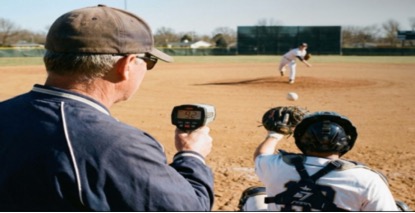
Whether you're clocking fastballs, analyzing bat swing mechanics, or tracking golf ball launch data, the right speed sensor transforms guesswork into measurable progress. We test radar guns, swing analyzers, and launch monitors to help athletes and coaches train smarter.
If you purchase through links on our site, we may earn an affiliate commission at no extra cost to you. This
helps support our testing.
Why Speed Measurement Matters for Training
You can't improve what you can't measure. Whether you're a Little League pitcher working toward your first 50 MPH fastball, a high school softball player refining swing mechanics, or a weekend golfer chasing more distance off the tee, objective speed data reveals exactly where you stand and tracks real progress over time.
This guide covers three categories of sports speed technology: radar guns that measure ball or puck velocity, swing analyzers that attach to bats and capture swing metrics, and golf launch monitors that track club speed, ball speed, launch angle, and more. Each serves different training needs, and we'll help you find the right tool for your sport and budget.
🎯 Best Speed Sensors by Category (Quick Recommendations)
Need the fastest answer? Start here. Each pick links to a detailed review below.
🎯 Find Your Perfect Training Device in 3 Questions
Answer a few quick questions and we'll recommend the best speed sensor for your specific needs.
1. What sport are you training for?
2. What do you want to measure?
3. What's your budget?
📡 Speed Radar Guns (Ball & Puck Velocity)
These devices measure how fast a ball or puck is moving through the air. Essential for pitchers tracking velocity gains, coaches evaluating player development, or anyone who wants hard data on throw speed.
The Pocket Radar Smart Coach is the benchmark for personal radar guns. Trusted by MLB scouts, college coaches, and serious travel ball parents, it delivers ±1 MPH accuracy from 120+ feet away. The Bluetooth connection to the Smart Coach app lets you track every pitch, chart velocity trends over a season, and share progress videos. Compact enough to fit in a bat bag but precise enough for professional evaluation.
±1 MPH accuracy verified against professional stadium guns
Measures speeds from 25-130 MPH at distances up to 120+ feet
Bluetooth Smart Coach app for session logging and video overlay
Hands-free mode with optional tripod mount for solo training
10+ hours battery life on 2 AAA batteries
Field take: This is what we recommend to anyone serious about pitching development. The app integration transforms raw speed readings into actionable training data.
Pros
Professional-grade accuracy trusted by MLB organizations
App tracks velocity trends and fatigue patterns over time
Compact size fits in any equipment bag
Works for baseball, softball, tennis, and more
Cons
Premium price point compared to basic radars
App subscription required for advanced analytics
Verdict: Best overall radar gun for serious players and coaches who want accurate data and progress tracking.
The Ball Coach delivers the same ±1 MPH professional accuracy as the Smart Coach in a slightly simpler package. No Bluetooth, no app—just point, shoot, and get an accurate reading on the bright LCD display. Perfect for coaches who want reliability without smartphone dependency, or for those who prefer to focus on the athlete rather than the screen.
±1 MPH accuracy matching professional stadium equipment
Speed range 25-130 MPH with clear LCD readout
Continuous trigger mode for back-to-back readings
Palm-sized design weighs just 4.5 oz
10+ hours on 2 AAA batteries
Field take: If you don't need app integration and just want dead-accurate readings, this is the one. It's what scouts use when they need a reliable number.
Pros
Same pro-level accuracy as Smart Coach
No smartphone needed—completely standalone
Extremely compact and durable
Simple operation with minimal learning curve
Cons
No data logging or trend tracking
Higher price than entry-level options
Verdict: Best standalone radar for coaches who value accuracy and simplicity over app features.
The TAG ONE bridges the gap between budget radars and professional equipment. It features a rechargeable battery (no more buying AAAs), smartphone app connectivity for session tracking, and accuracy within ±2 MPH. The app lets you record videos, overlay speed data, and share clips—making it popular with parents documenting their athlete's progress.
±2 MPH accuracy suitable for training use
Rechargeable battery eliminates disposable costs
Free app with video recording and speed overlay
Measures 10-200 MPH for multi-sport versatility
Compact design with built-in tripod mount
Field take: A solid mid-range choice for families who want app features without paying pro-level prices. The rechargeable battery is a nice quality-of-life upgrade.
Pros
Rechargeable battery saves money long-term
App includes video with speed overlay
Good accuracy for the price point
Works across multiple sports
Cons
Less accurate than Pocket Radar models
Newer product with smaller review base
Verdict: Best mid-range radar with app features for families on a budget.
The Bushnell Velocity is the radar that started countless pitching careers. At a fraction of the cost of professional units, it gives youth players and parents their first taste of velocity data. Accuracy runs ±3 MPH which is fine for general training, though serious competitive players will eventually want to upgrade. Point-and-shoot simplicity means anyone can use it immediately.
Measures 10-110 MPH with ±3 MPH accuracy
Large LCD display readable in various lighting
Point-and-shoot operation—no learning curve
Runs on C batteries for long life
Pistol-grip design comfortable for extended use
Field take: Perfect for youth sports and backyard fun. It's not scout-grade accurate, but it makes practice more engaging and gives kids something to chase.
Pros
Very affordable entry point
Dead simple to operate
Durable construction from trusted brand
Great for making practice fun
Cons
Less accurate than pro-level radars
Bulkier pistol-grip design
No app or data tracking
Verdict: Best entry-level radar for youth sports and casual training.
The Smart Partner 2.0 is designed for solo training sessions. Mount it on a tripod or set it behind home plate, and it calls out your pitch speed audibly—no need to look at a screen mid-session. This makes it ideal for pitchers working alone who want instant feedback without stopping to check readings. The voice announcement feature keeps you in your rhythm.
Audio voice announcement of each speed reading
Hands-free operation with tripod mounting
Measures 6-110 MPH for pitching and batting
LCD display with memory for reviewing sessions
Compact design sets up in seconds
Field take: The voice callout is genuinely useful for solo practice. Set it up, throw, and hear your speed without breaking focus.
Pros
Voice announcement enables solo training
Easy hands-free setup
Good accuracy for the price
Stores session data for review
Cons
Limited reviews as newer product
No smartphone app integration
Verdict: Best hands-free option for solo pitching practice.
The NetPlayz is the "fun" radar—an affordable way to add speed measurement to backyard games without breaking the bank. It works with baseball, soccer, tennis, and more, making it great for multi-sport families. Accuracy is basic (±5 MPH) and it works best at shorter distances, but for kids and casual use, it delivers exactly what families need: a number to chase.
Budget-friendly price for casual use
Hands-free tripod operation
Works with baseballs, soccer balls, tennis balls, etc.
Voice announcement of speed readings
Compact and kid-friendly operation
Field take: This is a toy-grade radar, and that's fine—it makes backyard practice more engaging for kids without a big investment.
Pros
Very affordable entry point
Multi-sport versatility
Voice feedback is fun for kids
Easy setup and operation
Cons
Lower accuracy than training-grade units
Limited range—best within 30 feet
Not suitable for serious training
Verdict: Best budget option for family fun and youth motivation.
Designed specifically for hockey players, the Potent Radar 2.0 measures slap shot, wrist shot, and snap shot velocities with a companion app that tracks your progress over time. It can handle the faster puck speeds that general-purpose radars sometimes struggle with, and the app gamification keeps training sessions engaging.
Optimized for hockey puck speeds up to 120+ MPH
Smartphone app tracks shot history and progress
Hands-free operation with included stand
Works for multi-sport use as well
Rechargeable battery included
Field take: The best dedicated hockey option. App gamification adds motivation for young players to keep practicing.
Pros
Designed for hockey's unique speed range
App tracks progress over time
Rechargeable battery
Hands-free operation
Cons
Mixed accuracy reports from users
App has some connectivity issues
Verdict: Best dedicated hockey shot speed tracker with app integration.
The CRANKSHOOTER is purpose-built for lacrosse players who want to track shot speed. It sets up behind the goal on a tripod and measures shots as they come through. The hands-free design means players can focus on their shooting form while the radar captures every attempt. Also works for baseball, hockey, and other sports.
Designed for lacrosse shot training scenarios
Hands-free tripod operation included
Measures speeds up to 150 MPH
Large LCD display readable from distance
Multi-sport compatible
Field take: Finally a radar marketed specifically for lacrosse. Setup is easy and it handles the sport's unique training scenarios well.
Pros
Designed with lacrosse training in mind
Includes tripod for hands-free use
Works for multiple sports
Good value for the features
Cons
No smartphone app connectivity
Smaller brand with less support infrastructure
Verdict: Best radar specifically designed for lacrosse shot training.
These sensors attach to your bat and capture detailed swing data including bat speed, attack angle, time to contact, and rotation. They reveal the "why" behind your results—helping hitters understand and improve their mechanics.
The Blast Motion sensor is used by MLB organizations, college programs, and serious travel ball players to understand swing mechanics at a granular level. It attaches to your bat knob and captures bat speed, attack angle, time to contact, rotational acceleration, and more. The app provides video overlay with metrics and compares your swings to professional benchmarks.
Measures bat speed, peak hand speed, and attack angle
Tracks time to contact and on-plane efficiency
Auto-captures video with metric overlay
Used by 27 MLB organizations for player development
Fits any bat—wood, aluminum, or composite
Field take: The gold standard for swing analysis. If you're serious about understanding and improving hitting mechanics, this is the tool.
Pros
Professional-grade swing metrics trusted by MLB
Video sync shows exactly what each number means
Tracks progress over weeks and seasons
Works with any bat type
Cons
Learning curve to understand all metrics
Premium subscription unlocks best features
Verdict: Best swing analyzer for serious hitters who want pro-level mechanics data.
The softball-specific version of Blast Motion's sensor is calibrated for the unique mechanics of softball hitting. Same great technology as the baseball version, but with benchmarks, drills, and analysis tailored to softball swing patterns. It's the official sensor of USA Softball and used by elite programs nationwide.
Calibrated specifically for softball swing mechanics
Official sensor of USA Softball
Tracks all the same metrics as baseball version
Softball-specific drills and benchmarks in app
Fits any softball bat
Field take: Identical technology to the baseball version, just optimized for softball. If you play fastpitch, this is the one to get.
Pros
Softball-specific calibration and benchmarks
Same pro-level accuracy as baseball version
USA Softball official partner
Great app with video sync
Cons
Premium subscription for full features
Takes time to learn all the metrics
Verdict: Best swing analyzer specifically optimized for softball players.
Golf launch monitors measure club speed, ball speed, launch angle, spin rate, and carry distance. They transform practice sessions from guesswork into data-driven improvement, and many now include virtual course play for year-round training.
The Garmin R10 brings launch monitor technology to a portable, affordable package. Using Doppler radar, it tracks club head speed, ball speed, launch angle, spin, and more—then feeds that data into the Garmin Golf app where you can play over 42,000 virtual courses. Set it up indoors or outdoors in seconds and get pro-level insights on every swing.
Tracks club speed, ball speed, smash factor, launch angle, spin
Access to 42,000+ virtual courses via Garmin Golf app
Indoor and outdoor use with minimal setup
10+ hour rechargeable battery life
Compact and portable—fits in your golf bag
Field take: The best value in launch monitors. You get serious data plus virtual play at a fraction of what premium units cost.
Pros
Outstanding value for the data provided
42,000+ courses for home simulator play
Truly portable—sets up in seconds
Great app integration with Garmin ecosystem
Cons
Occasional accuracy variance vs. $5K+ units
Premium app features require subscription
Verdict: Best portable launch monitor for golfers who want real data without spending thousands.
The MLM2PRO combines radar and camera technology to deliver launch data alongside synchronized video of your swing. See your numbers overlaid on slow-motion playback to understand exactly what each metric means in your motion. Great for visual learners who want to connect data to mechanics.
Dual radar + camera for comprehensive data
Video capture with metric overlay synced to swing
Tracks 13+ metrics including spin axis and curve
Indoor and outdoor modes
Shot tracer visualization on video
Field take: The video integration is genuinely useful—seeing your swing alongside the data makes understanding issues much faster.
Pros
Video sync makes data actionable
Comprehensive 13+ metrics
Shot tracer is satisfying and useful
Great for lessons and self-coaching
Cons
Higher price than basic monitors
Some users report occasional misreads
Verdict: Best launch monitor for visual learners who want to see their swing alongside data.
TheStack is a unique speed training system that combines a Doppler radar with a scientifically-designed training protocol. The included training sticks of varying weights, paired with the app's guided workouts, are designed to increase your swing speed over 8-12 weeks. It's training and measurement in one package.
Speed training protocol backed by sports science
Includes weighted training sticks for overspeed work
App guides you through progressive speed workouts
Tracks swing speed and training progress
Portable enough for range or home use
Field take: More than just a radar—it's a complete speed training system. If distance gains are your goal, this structured approach works.
Pros
Complete speed training system, not just measurement
Guided workouts take guesswork out of training
Users report real speed gains with consistent use
Portable and easy to use anywhere
Cons
Focused on speed, not full launch data
Subscription for ongoing training protocols
Verdict: Best system for golfers specifically focused on increasing swing speed.
The PRGR is a no-frills golf radar that gives you the essentials: club speed, ball speed, and estimated carry distance. No smartphone required—just set it down, swing, and read the LCD. It's popular for range sessions where you want quick feedback without the complexity of full launch monitor setups.
Measures club speed, ball speed, and carry distance
No app required—standalone LCD display
Simple setup takes seconds
Battery powered for portability
Compact size fits in any golf bag
Field take: Perfect for golfers who just want speed and distance without app complexity. Set it down and swing.
Pros
Dead simple operation—no phone needed
Reliable accuracy for core metrics
Very portable and quick to set up
Great value for basic launch data
Cons
Limited metrics compared to full monitors
No data logging or history tracking
Verdict: Best simple golf radar for quick speed and distance feedback at the range.
The original Rapsodo Mobile Launch Monitor uses your smartphone camera to capture ball flight and calculate launch data. Position your phone behind the hitting area and it tracks carry distance, ball speed, launch angle, and direction. A great entry point into launch monitor technology.
Uses iPhone camera for ball flight tracking
Measures carry distance, ball speed, launch angle
Shot tracer video for every swing
GPS course integration for on-course use
More affordable than radar-based alternatives
Field take: The most affordable way to get into launch data. iPhone-dependent, but the video shot tracer is genuinely satisfying.
Pros
Affordable entry into launch monitor data
Shot tracer video is useful and fun
Works at the range or on the course
Good app with GPS mapping
Cons
iOS only (iPhone required)
Camera-based system has lighting limitations
Less accurate than radar-based monitors
Verdict: Best budget entry into golf launch data for iPhone users.
🔬 How We Research & Evaluate Speed Sensors & Launch Monitors
Our evaluation process combines hands-on experience, detailed specification analysis, and aggregated user feedback to deliver recommendations you can trust:
Accuracy Evaluation
Specification analysis: Manufacturer-stated accuracy ratings and technology comparisons
User-reported consistency: Patterns from verified reviews on repeatability and reliability
Professional benchmarks: How devices compare against known standards in real-world use
Range and conditions: Documented performance at different distances and environments
Real-World Usage Assessment
Skill level coverage: Feedback from youth players through adult athletes
Environmental factors: Indoor vs. outdoor performance, lighting considerations
App functionality: Sync reliability, data logging, and usability reports
Battery life: Manufacturer specs verified against owner-reported runtime
Long-Term Reliability
Extended use feedback: Owner reviews after weeks and months of use
Common failure points: Patterns identified from verified purchase reviews
Build quality: Materials, construction, and durability reports
📊 Our Approach: Where possible, we evaluate devices firsthand. For units we haven't personally tested, we rely on thorough specification analysis, manufacturer documentation, and verified owner feedback. We prioritize retail availability, avoid pay-for-play placements, and update picks when new models change the landscape.
🛒 Buyer's Guide: Choosing the Right Speed Sensor
Radar Guns vs. Swing Analyzers vs. Launch Monitors
Speed Radar Guns measure how fast an object is moving through space. Point it at a pitch, throw, or shot and get a velocity reading. Best for: pitchers tracking velocity, coaches evaluating players, parents wanting objective data.
Swing Analyzers attach to your bat and capture the mechanics of your swing—bat speed, attack angle, time to contact, and more. Best for: hitters who want to understand and improve their swing mechanics.
Golf Launch Monitors track the ball after impact, measuring ball speed, launch angle, spin rate, and carry distance. Many also measure club speed. Best for: golfers who want comprehensive shot data for practice and fitting.
Accuracy: How Much Does It Matter?
±1 MPH: Professional-grade accuracy. Essential for scouts, serious training, and tracking small velocity gains over time. Pocket Radar devices hit this standard.
±2-3 MPH: Training-grade accuracy. Good enough to track general progress and make practice more engaging. Most mid-range devices fall here.
±4-5+ MPH: Recreation-grade accuracy. Fine for fun and motivation, but not reliable for tracking real development. Budget devices like NetPlayz operate here.
App Connectivity: Worth the Extra Cost?
Apps add significant value if you want to track progress over weeks and months. Features like video overlay, velocity charts, and session history turn individual readings into actionable training data. If you just want a number in the moment, standalone devices work fine.
Hands-Free vs. Point-and-Shoot
Point-and-shoot radars (Bushnell Velocity, Pocket Radar) require someone to aim at the target. Great when you have a partner or coach.
Hands-free devices (Smart Partner 2.0, NetPlayz) mount on a tripod and capture everything that passes through their detection zone. Essential for solo practice.
🚫 5 Costly Mistakes to Avoid When Buying Speed Sensors
Expecting budget radars to match pro accuracy
A $50 radar will give you ballpark numbers, not the ±1 MPH precision that reveals real velocity gains. If tracking development matters, invest in Pocket Radar or similar pro-grade equipment.
Ignoring your actual use case
Radar guns measure ball speed. Swing analyzers measure bat mechanics. Launch monitors measure ball flight. They're different tools for different goals. A swing analyzer won't tell you pitch velocity, and a radar won't tell you attack angle.
Overlooking app subscription costs
Many devices offer basic functionality for free but require subscriptions for advanced features. Factor in ongoing costs when comparing total value.
Buying a golf launch monitor for baseball
Golf launch monitors are designed for golf ball flight characteristics. While some can measure other objects, they're not optimized for baseball or softball. Get sport-specific equipment.
Prioritizing features over fundamentals
A reliable, accurate device you'll actually use beats a feature-packed unit that's too complicated. Start with what you need, not what sounds impressive.
📘 Quick Guide: Getting Accurate Radar Readings
Position correctly: For best accuracy, position yourself (or the radar) directly behind or in front of the target's line of travel. Angle reduces accuracy.
Optimal distance: Most personal radars work best at 20-60 feet. Too close and they may not register; too far and accuracy decreases.
Minimize interference: Other moving objects, metal structures, and electronic devices can affect readings. Test in clear environments.
Consistent conditions: For tracking progress, use the same device, position, and conditions each session.
Multiple readings: Take several readings and look at averages. One-off numbers can be misleading.
❓ Frequently Asked Questions
What's the most accurate radar gun under $300?
The Pocket Radar Smart Coach delivers ±1 MPH accuracy—the same precision used by MLB organizations—at under $300. It's the best value for serious training accuracy.
Do I need a radar gun or a swing analyzer?
They measure different things. A radar gun tells you how fast the ball is moving. A swing analyzer tells you how you're swinging the bat (speed, angle, mechanics). Pitchers typically want radar guns; hitters benefit more from swing analyzers.
Can I use a baseball radar for golf?
Technically yes for basic speed, but golf-specific launch monitors provide much more useful data—launch angle, spin rate, carry distance, and club path. For serious golf training, get a golf launch monitor.
How accurate are budget radar guns?
Budget radars like the Bushnell Velocity and NetPlayz typically have ±3-5 MPH accuracy. That's fine for general fun and motivation but not reliable enough to track small velocity gains over time. Serious training requires ±1-2 MPH devices.
What's the best radar for youth baseball?
For casual youth use, the Bushnell Velocity is affordable and fun. For tracking development seriously, the Pocket Radar Smart Coach is worth the investment—accurate data helps coaches and parents make better training decisions.
Can I use a launch monitor indoors?
Yes, most modern launch monitors like the Garmin R10 and Rapsodo MLM2PRO work indoors. You'll need adequate ceiling height (10+ feet) and hitting into a net. Check specific product requirements for minimum space.
How much space do I need for a golf launch monitor?
Most portable launch monitors need 8-10 feet of ceiling height and about 10 feet of ball flight before hitting a net. Check your specific device requirements, as some need more or less space for accurate readings.
Are app subscriptions worth it?
If you'll use the tracking features, yes. Apps transform individual readings into progress charts, video libraries, and actionable insights. If you just want spot-checks, standalone devices without subscriptions work fine.
What's the difference between the Pocket Radar Smart Coach and Ball Coach?
Same ±1 MPH accuracy. The Smart Coach adds Bluetooth and app connectivity for tracking sessions over time. The Ball Coach is standalone—no phone needed. Choose Smart Coach for data tracking, Ball Coach for pure simplicity.
Can radar guns work for hockey and lacrosse?
Yes. The Potent Hockey Radar 2.0 is optimized for puck speeds, and the CRANKSHOOTER is designed for lacrosse. Multi-sport radars like Pocket Radar also work, though sport-specific options may offer better ergonomics for those training scenarios.
👤 About the Author
I’m Michael Taft, founder of Products For Our Lives. This site exists to share the same research and testing my son and I do before buying gear we actually use—especially tools that need to be accurate and dependable in real situations.
Radar guns became part of our gear through years of coaching youth baseball. As a coach, I needed a consistent, objective way to evaluate players during practices and tryouts—especially when working with kids at different stages of development. That led me to research radar guns that could deliver reliable readings without being overly complicated or fragile for field use.
Evaluation background: youth baseball coaching experience; B.S. in Computer Engineering Technology; Director of Software Engineering.
Methodology: I compare accuracy consistency, pickup reliability, ease of use, durability, battery behavior, and app or display clarity. I verify manufacturer specifications where possible and weigh long-term owner feedback to identify common issues like missed reads or hardware failures.
December 28, 2025: Initial publication with 15 reviewed & tested devices across baseball, golf, hockey, and lacrosse
We continuously review & test new models and update this guide. Next scheduled update: March 2026
📚 Related Radar Gun & Speed Sensor Guides
Want deeper accuracy tips, training ideas, and real-world testing notes? These radar-gun and speed-sensor guides help you
choose the right device, set it up correctly, and get reliable readings for baseball, hockey, golf, and more.